
Surah Al-Kahf (The Cave) is the 18th chapter of the Holy Quran, revealed in Makkah during intense persecution of early Muslims. Comprising 110 verses, it holds an extraordinary status in the weekly spiritual life of believers. Prophet Muhammad (peace be upon him) explicitly emphasized its recitation on every Friday (Jummah), establishing it as an illuminating beacon of light and an unyielding spiritual shield against the catastrophic deceptions of the Antichrist (Al-Masih ad-Dajjal). This comprehensive analytical guide explores the historical background of Surah Kahf, its four profound parables, authentic Hadith virtues, theological connections to end-times trials, and actionable lessons for contemporary believers.
Prophetic Declaration: “Whoever recites Surah Al-Kahf on the day of Friday, a light will shine for him from beneath his feet to the clouds of the sky, illuminating him on the Day of Resurrection, and he will be forgiven for what is between the two Fridays.” (Sunan al-Bayhaqi, 5856; authenticated by Al-Albani in Sahih al-Targhib: 736)
| Attribute | Details |
|---|---|
| Surah Position | Chapter 18 of the Holy Quran |
| Juz Placement | Juz 15 (verses 1-74) and Juz 16 (verses 75-110) |
| Total Verses | 110 Verses (Ayahs) |
| Revelation Period | Makki (Middle Makkan Period) |
| Rukus (Sections) | 12 Rukus |
| Core Thematic Focus | Four primary trials of humanity (Faith, Wealth, Knowledge, Power) and divine guidance |
Historical Background and Reason for Revelation (Sabab an-Nuzul)
Classical Quranic commentators, notably Imam Ibn Kathir and Imam At-Tabari, record that the chieftains of the pagan Quraish in Makkah dispatched Nadr ibn al-Harith and Uqbah ibn Abi Mu’ayt to the Jewish rabbis of Yathrib (Madinah). Because Jewish scholars possessed deep knowledge of prior prophetic scriptures, the Quraish sought their counsel to test the authenticity of Prophet Muhammad’s prophethood.
The rabbis instructed the emissaries to ask the Prophet three specific questions:
- Ask him about the young men who fled their people in ancient times and what their extraordinary story was.
- Ask him about the great traveler who journeyed to the eastern and western extremities of the known earth.
- Ask him about the nature and reality of the Spirit (Ruh).
When the Quraish presented these challenges, the Prophet promised to answer tomorrow without explicitly uttering “In sha’ Allah” (if Allah wills). Consequently, divine revelation paused for approximately fifteen days, causing temporary distress among Muslims and boastful mockery among idolaters. Then, Angel Jibril descended with Surah Al-Kahf, addressing the youth of the cave, the great ruler Dhul-Qarnayn, and delivering the vital moral injunction: “And never say of anything, ‘I shall do such and such thing tomorrow,’ except [with the saying], ‘If Allah wills!'” (Surah Al-Kahf 18:23-24).
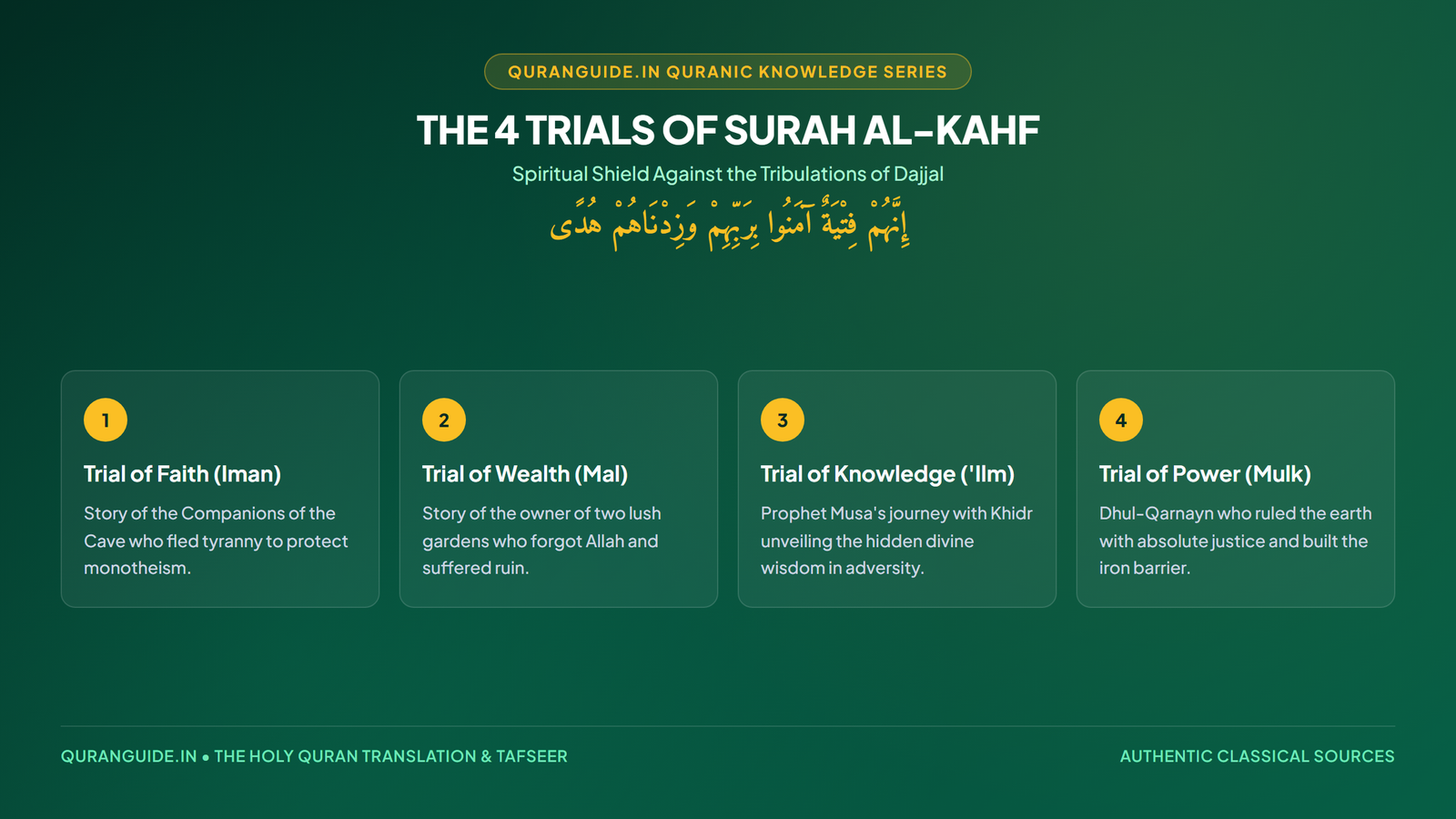
The 4 Central Parables and Their Spiritual Antidotes
1. The Trial of Faith (Fitnah of Religion): The Companions of the Cave (Ashab al-Kahf)
A group of upright monotheistic young believers lived under a ruthless pagan monarch (historically associated with Emperor Decius). Facing the death penalty for refusing to worship idols, they abandoned their wealth, family prestige, and worldly comforts, taking sanctuary in a secluded mountain cavern. In miraculous response to their sincere supplication, Allah caused them to enter a profound deep sleep lasting over 300 solar years (309 lunar years), with their loyal dog resting at the threshold. Divine providence preserved their physical bodies from decomposition by turning them from right to left while keeping the sunlight from burning them. When they awoke, thinking only a day or part of a day had elapsed, their city had transformed completely into a society honoring their faith.
The Divine Antidote: True religious resilience requires righteous companionship (Suhbah Salihah), unshakeable reliance on Allah’s ultimate protection, and the perpetual remembrance of their supplication: “Our Lord, grant us from Yourself mercy and prepare for us from our affair right guidance.” (18:10).
2. The Trial of Wealth (Fitnah of Wealth): The Owner of the Two Gardens
The second parable contrasts two men: one endowed with lush, productive vineyards encircled by date palms and irrigated by flowing streams, and another of modest financial means but unwavering conviction. The affluent owner succumbed to pride, asserting his estate would endure forever and questioning the reality of the Day of Judgment. His destitute yet wise companion cautioned him against arrogance, advising him to recognize that all bounty stems exclusively from Allah by declaring: “Ma sha’ Allah, la quwwata illa billah” (What Allah wills [occurs]; there is no power except in Allah). Blinded by conceit, the owner disregarded the counsel. In a single night, a catastrophic divine storm destroyed his fertile groves, reducing them to ruined rubble and leaving him in bitter, helpless remorse.
The Divine Antidote: Acknowledging the fleeting nature of material possessions, expressing continuous gratitude to the Creator, and recognizing that wealth is a transient trust, not a measure of divine favor.
3. The Trial of Knowledge (Fitnah of Intellect): Prophet Musa and Al-Khidr
Prophet Musa (Moses), after addressing the Children of Israel, was once asked if there existed anyone on earth more knowledgeable than him. When he replied no, Allah gently corrected him and instructed him to travel to the junction of the two seas to meet a servant endowed with special esoteric divine knowledge—Al-Khidr. Accompanying Khidr under the condition that he refrain from questioning any action until explained, Musa witnessed three baffling events: Khidr made a damaging hole in a boat belonging to destitute fishermen; he terminated an apparently blameless young boy; and he repaired a crumbling wall in a village whose residents had inhospitably refused them food.
Musa could not remain silent, raising heartfelt objections. Khidr subsequently unveiled the benevolent divine wisdom behind each action: the boat was scuttled to protect the poor fishermen from an oppressive king who was confiscating every undamaged vessel; the boy was destined to tyrannize his righteous parents with disbelief and grief, and Allah replaced him with a righteous daughter; and the wall concealed buried treasure belonging to two orphan boys whose father had been righteous, preserving their inheritance until maturity.
The Divine Antidote: Intellectual humility, patient submission to divine decree (Qadar), and understanding that human reasoning observes merely outward appearances, whereas divine decree orchestrates profound hidden benevolence.
4. The Trial of Power (Fitnah of Authority): The Sovereign Dhul-Qarnayn
The final parable recounts Dhul-Qarnayn, a righteous global sovereign granted vast technological mastery, military supremacy, and administrative reach. Rather than using power for tyrannical conquest, he traveled to the distant west, east, and between two mountains, executing equitable justice. When he encountered a vulnerable population tormented by the catastrophic invasions of Gog and Magog (Yajuj and Majuj), they offered him monetary tribute to erect a wall of protection. Dhul-Qarnayn refused their wealth, declaring that the power granted by his Lord was superior. He instructed them to supply raw labor and iron blocks, forging a massive metallurgical rampart reinforced with molten copper. Upon completion, he attributed zero credit to his intellect or army, proclaiming: “This is a mercy from my Lord. But when the promise of my Lord comes, He will level it, and the promise of my Lord is ever true.” (18:98).
The Divine Antidote: Utilizing political, physical, and financial leadership as a selfless trust (Amanah), protecting the vulnerable, and displaying deep humility before Allah’s ultimate dominion.
The Thematic Link Between Surah Al-Kahf and the Antichrist (Al-Masih ad-Dajjal)
Islamic scholars, including Sheikh Ibn Uthaymeen and Dr. Yasir Qadhi, observe a profound symmetry between the four trials of Surah Al-Kahf and the exact tribulations that the Antichrist (Dajjal) will inflict upon mankind during the end times:
- Trial of Faith: Dajjal will demand that humans recognize him as deity, threatening those who maintain pure monotheism with execution, mirrored by the youth fleeing the pagan tyrant.
- Trial of Wealth: Dajjal will command rainfall and agricultural fertility over followers while leaving deniers in famine, mirrored by the rich owner of the two gardens.
- Trial of Knowledge: Dajjal will deceive intellects through false miracles and supernatural illusions, mirrored by the hidden wisdom taught through Musa and Khidr.
- Trial of Power: Dajjal will conquer virtually the entire planet with unrivaled velocity and dominion, mirrored by the global realm and righteous power of Dhul-Qarnayn.
By reciting Surah Al-Kahf every Friday, a Muslim subconsciously fortifies the heart and mind against all contemporary manifestations of these four universal human traps.
Authentic Hadith Virtues of Reciting Surah Kahf on Friday
- Spiritual Light (Nur) Between Fridays: Abu Sa’id al-Khudri (RA) reported that the Prophet (peace be upon him) said: “Whoever recites Surah Al-Kahf on Friday, light will shine for him from one Friday to the next.” (Sunan al-Nasa’i al-Kubra: 10790; authenticated by Sheikh al-Albani in Sahih al-Jami: 6470).
- Immunity from the Fitnah of Dajjal: Abu al-Darda (RA) narrated that the Prophet (peace be upon him) stated: “Whoever commits to memory the first ten verses of Surah Al-Kahf will be protected from the trial of the Dajjal.” (Sahih Muslim: 809). In another narration of Sahih Muslim, the last ten verses are also cited.
- Forgiveness of Sins: Reciting this chapter provides spiritual purification, forgiving minor transgressions committed between consecutive Fridays.
- Peace and Tranquility (Sakinah) Descending: Al-Bara ibn Azib (RA) reported that a man was reciting Surah Al-Kahf when a cloud enveloped him, moving closer and causing his horse to startle. The Prophet (peace be upon him) explained: “That was tranquility which descended on account of the recitation of the Quran.” (Sahih al-Bukhari: 5011; Sahih Muslim: 795).
Recommended Related Surah & Historical Guides
- Ashab-e-Kahf Waqia in Hindi — Detailed historical chronicle of the Seven Sleepers in Urdu and Hindi.
- All Surahs Archive — Complete library of Quranic chapters with transliteration and commentary.
- Quran in Hindi Collection — Simplified, authentic Hindi translations of classical Quranic texts.
Frequently Asked Questions (FAQs)
1. When does the timeframe to recite Surah Kahf begin and end on Friday?
In the Islamic lunar calendar, Friday commences immediately at sunset (Maghrib) on Thursday evening and concludes at sunset on Friday. Believers may recite Surah Al-Kahf anytime within this 24-hour window to attain its complete blessings.
2. How does memorizing the first or last ten verses protect against Dajjal?
The first ten verses establish absolute monotheism, the perfection of revelation, and warn against attributing partners to Allah, while the final ten verses dismantle materialistic hubris. Memorizing and reflecting upon these verses equips the believer’s intellect with unwavering discernment against the Dajjal’s deceptive illusions.
3. Can Surah Kahf be recited in installments across Friday?
Yes. While completing the chapter in a single sitting is virtuous, dividing its 110 verses across different prayers—such as reciting portions after Fajr, Dhuhr, and Asr—is entirely permissible and valid under Islamic jurisprudence.
4. What are the four core trials illustrated in Surah Al-Kahf?
The four parables delineate the Trial of Faith (The Companions of the Cave), the Trial of Wealth (The Owner of the Two Gardens), the Trial of Knowledge (Prophet Musa and Al-Khidr), and the Trial of Power and Leadership (Dhul-Qarnayn).
5. Is listening to an audio recitation of Surah Kahf equivalent to reciting it?
Listening attentively to the Quran yields immense reward and divine mercy. However, to attain the specific Prophetic promise of light and forgiveness mentioned in Hadiths, verbal recitation by the individual (moving the lips and tongue) is strongly recommended whenever possible.


