

After offering Salat al-Istikhara and pouring your heart into the Prophetic supplication, the most pressing question inevitably arises: “How do I know what Allah has chosen for me? Did my prayer work if I didn’t see a dream or colors in my sleep?”
Few aspects of Islamic worship are as shrouded in cultural superstition and confusion as understanding istikhara signs and results. Millions of believers paralyze themselves waiting for a magical sign, an angelic dream, or a green light, while classical Islamic scholarship paints a completely different, empowering picture rooted in rational action and spiritual tranquility.
“And decree for me what is good wherever it may be, and make me content with it.”
— Closing petition of Salat al-Istikhara, Sahih al-Bukhari (1162)
(Looking for the complete prayer walkthrough or exact Arabic wording? Explore our guides on How to Pray Istikhara Step by Step and Istikhara Dua in English, Arabic & Transliteration).
The Myth of Dreams & Colors: What the Sunnah Actually Says
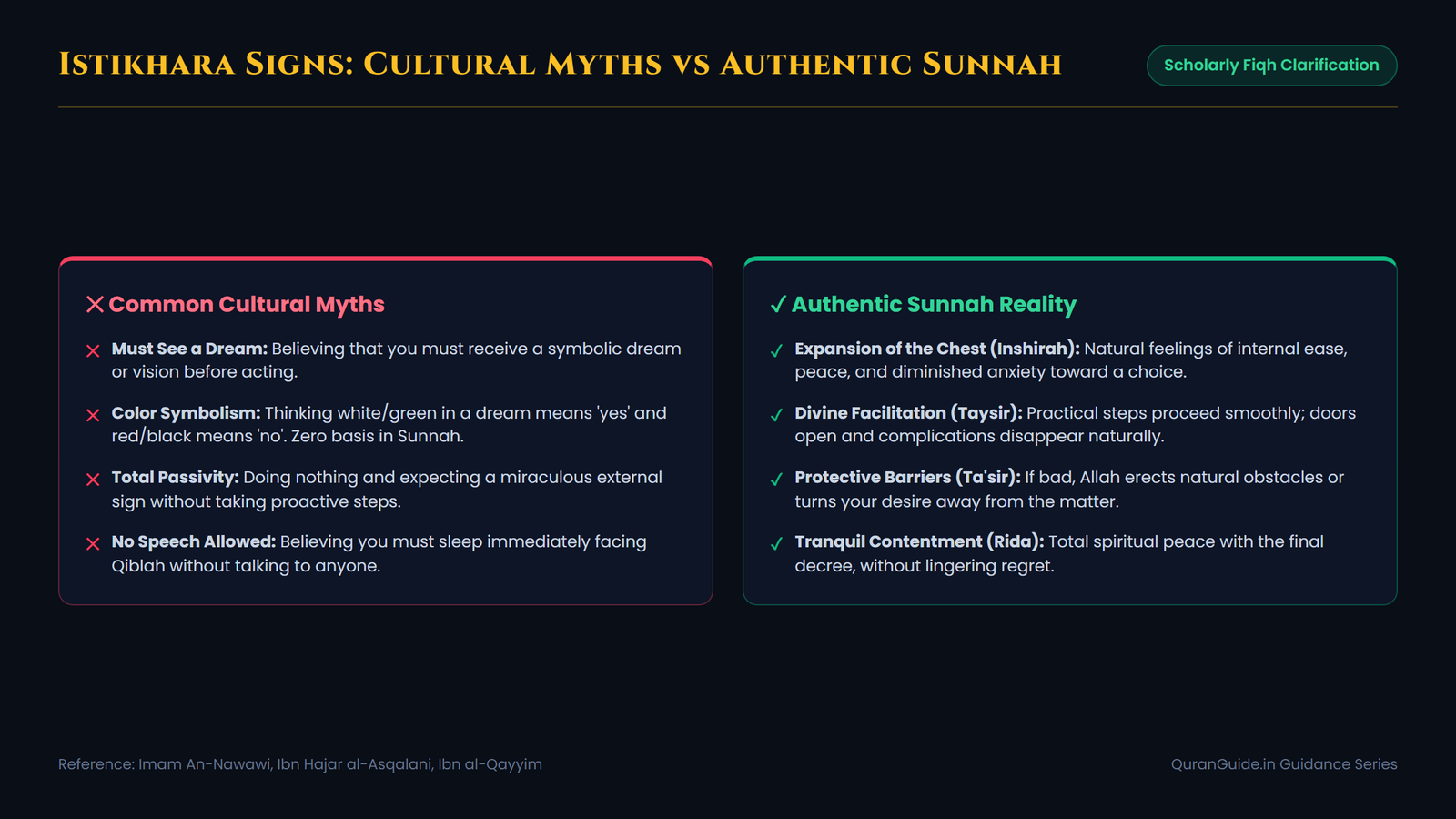
Let us state this clearly based on consensus across all four classical Madhhabs (Hanafi, Maliki, Shafi’i, and Hanbali): Having a dream is NOT a condition, requirement, or primary sign of Istikhara.
The Prophet Muhammad ﷺ never instructed his companions to go to sleep immediately after Istikhara, nor did he instruct them to interpret dreams, colors, or celestial omens. While a true, righteous dream (Ru’ya Sadiqah) is a general form of good tiding from Allah, tying Istikhara specifically to dreams is a later cultural distortion.
What Did Classical Scholars State About Dreams?
The great hadith master Imam Ibn Hajar al-Asqalani (author of Fath al-Bari) and Imam An-Nawawi clarified:
“A person who makes Istikhara should not rely on what he felt before the prayer, nor should he wait for a dream. Rather, he should proceed with determination in the affair. If it is good, Allah will facilitate it, and if it is evil, Allah will divert it from him.”
— Sharh Sahih Muslim by Imam An-Nawawi
The common folk belief that “seeing white or green signifies yes, while seeing red or black signifies no” has zero authentic evidence in the Quran, Sunnah, or early scholarly texts. Dreams are easily influenced by subconscious anxieties, pre-existing desires, diet, and spiritual whispers (Hadith al-Nafs).
The 3 Authentic Ways Allah Truly Answers Istikhara
When you pray Istikhara with sincere submission, Allah Almighty answers your supplication through three tangible, real-world mechanisms:
1. Expansion of the Chest (Inshirah al-Sadr) vs. Constriction (Diq)
The first sign often manifests internally. Before Istikhara, your mind was torn by conflicting scenarios, stress, and circular thinking. Following the prayer:
- Positive Indicator (Inshirah): You experience a serene, intuitive clarity. A deep sense of peace and natural resolution settles in your heart toward taking a specific path, free from frantic desperation.
- Negative Indicator (Diq al-Sadr): You feel persistent internal hesitation, spiritual heaviness, or intuitive discomfort that does not fade, signaling that this path may carry hidden harm for your worldly or spiritual life.
2. Divine Facilitation (Taysir) vs. Protective Roadblocks (Ta’sir)
Remember the precise words of the Dua you uttered: “Faqdurhu li wa yassirhu li” (Decree it for me and ease it for me). The most decisive sign of Istikhara is how reality unfolds around you:
- When the Decision is Good for You: The doors open smoothly with remarkable ease. Bureaucratic hurdles dissolve, both parties agree, terms fall neatly into place, and you encounter unexpected blessings (Barakah) at every step.
- When the Decision is Harmful: Continuous, insurmountable barriers suddenly arise. The other party changes their mind, financial backing evaporates, visa applications fail, or fundamental red flags are unveiled. This is not “bad luck”—this is Allah directly fulfilling your request: “fasrifhu ‘anni wasrifni ‘anhu” (turn it away from me, and turn me away from it)!
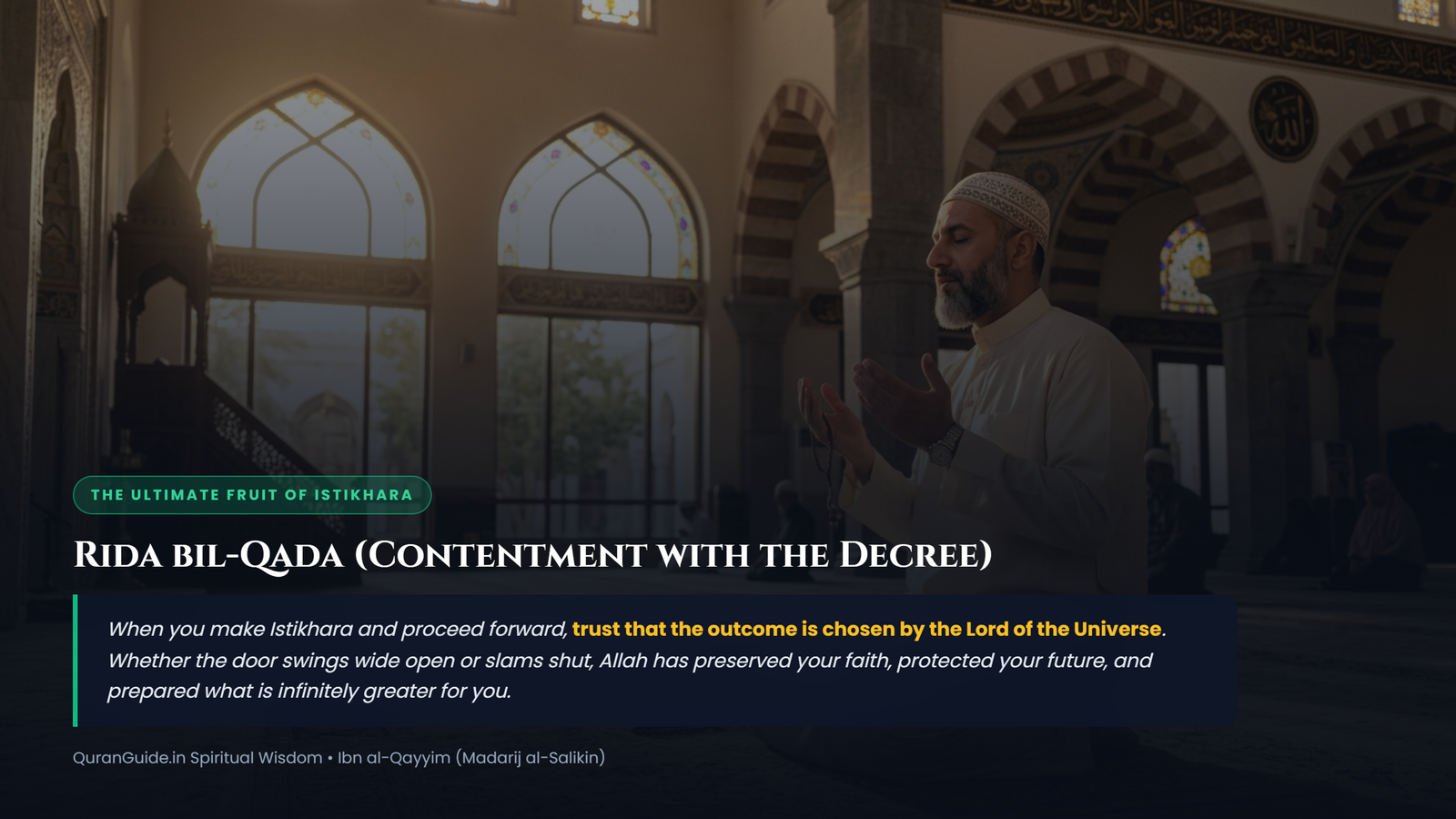
3. The Gift of Contentment (Rida bil-Qada)
Perhaps the highest fruit of Istikhara is the inner peace that accompanies whatever happens. Even if a marriage proposal falls apart, a job offer is rescinded, or an investment falls through, the believer who made Istikhara does not spiral into despair or bitterness. You rest securely in the knowledge that the Creator of the Heavens and the Earth stepped in to shield you from unseen catastrophe.
What Should You Do Immediately After Praying Istikhara?
Many people freeze after praying Istikhara, expecting an external sign to push them. The Sunnah instruction is to take proactive, decisive action:
- Move forward with your best judgment: Take the next practical step—send the reply, sign the agreement, schedule the meeting, or submit the paperwork.
- Watch for Allah’s steering: If the affair progresses with harmony and ease, proceed with gratitude. If doors repeatedly slam shut, walk away with dignity and peace.
- Never second-guess: Once a matter concludes following Istikhara, never say: “If only I had done XYZ…”. Prophet Muhammad ﷺ warned: “The phrase ‘if only’ opens the door to the work of Shaytan” (Sahih Muslim 2664). Trust Allah’s divine decree unconditionally.
(Navigating a marriage choice specifically? Read our targeted guide: How to Pray Istikhara for Marriage: Signs, Duas & Step-by-Step Guide).
What If You Feel Nothing or Remain Confused?
If your heart remains neutral or undecided following your prayer, follow these three practical Sunnah steps:
- Repeat the Prayer: Repeat Salat al-Istikhara across multiple consecutive days (up to 7 days). Consistency deepens humility and allows subtle clarity to emerge. (Review timing recommendations in our guide on Best Time to Pray Istikhara: Tahajjud, Forbidden Times & Frequency Rules).
- Engage in Further Consultation (Mashwara): Revisit the decision with knowledgeable, objective elders or experts in the field.
- Detach from Personal Desires: Ensure that subconscious attachment or stubborn pride is not clouding your receptivity to Allah’s answer.
Explore All Articles in Our Complete Istikhara Series
Discover our complete, interconnected guides on Istikhara:
- The Master Pillar Guide: How to Pray Istikhara Step by Step: Full Method, Duas & Sunnah Rules
- Supplication & Meaning: Istikhara Dua in English, Arabic & Transliteration with Meaning
- Marriage & Proposals: How to Pray Istikhara for Marriage: Signs, Duas & Step-by-Step Guide
- Optimal Timings: Best Time to Pray Istikhara: Tahajjud, Forbidden Times & Frequency Rules
Frequently Asked Questions (FAQs)
1. How long does it take to see the results of Istikhara?
There is no fixed timeline. Sometimes clarity arises within hours; other times, the answer unfolds across days or weeks as events develop. Observe the flow of circumstances rather than expecting an instantaneous flash.
2. What if I had a bad dream after praying Istikhara?
Do not panic. Nightmares and disturbing dreams come from Shaytan (Hulum) to induce fear and doubt. Spit lightly three times to your left, seek refuge in Allah from Shaytan, and do not let a bad dream derail a beneficial Halal decision.
3. If a marriage or job fails later, does it mean my Istikhara was wrong?
No, never. Sometimes Allah guides you into an experience that tests you, elevates your spiritual ranks, builds resilience, or protects you from an even greater catastrophe. The goodness (Khayr) promised in Istikhara includes both worldly and eternal dimensions known only to Allah.


