
Salat al-Istikhara (صَلَاةُ الاسْتِخَارَة) is one of the most powerful spiritual tools gifted to believers by Prophet Muhammad ﷺ. When facing important life choices—whether deciding on a marriage proposal, changing a career, purchasing a home, or undertaking a journey—making Istikhara allows you to surrender your anxiety and seek divine clarity directly from Allah Almighty.
The Messenger of Allah ﷺ prioritized this prayer so deeply that his companion Jabir ibn Abdullah (may Allah be pleased with him) narrated:
“The Messenger of Allah ﷺ used to teach us to seek guidance from Allah (Istikhara) in all matters, just as he used to teach us a Surah from the Quran.”
— Sahih al-Bukhari (1162)
In this comprehensive guide, you will learn how to pray istikhara prayer step by step, what specific Surahs to recite, when and how to recite the authentic supplication, essential Sunnah rules, and how to understand the outcome with complete trust in Allah.
What is Istikhara in Islam? Meaning & Purpose
The word Istikhara (اِسْتِخَارَة) derives linguistically from the Arabic root Kh-Y-R (خير), meaning “goodness” or “well-being.” In Islamic jurisprudence (Fiqh), Salat al-Istikhara means actively seeking Allah’s guidance to direct you toward what is best for your worldly life, your faith, and your ultimate Hereafter.
Unlike secular decision-making methods that rely strictly on limited human logic, performing Istikhara connects your human consultation (Mashwara) with the Infinite Knowledge and Mercy of the Creator. You acknowledge that Allah knows the hidden future (Al-Ghayb), whereas human wisdom is inherently constrained.
When Should You Pray Istikhara?
A widespread misconception is that Istikhara is only reserved for massive life events like weddings or life-changing relocations. While it is crucially recommended for these milestones, the Prophet ﷺ advised seeking Allah’s guidance in all permissible (Mubah) or recommended (Mustahabb) affairs where a choice must be made between two or more valid options:
- Marriage & Proposals: Choosing between suitors or deciding whether to accept a specific marriage proposal. (Read our detailed guide on How to Pray Istikhara for Marriage).
- Career, Business & Education: Accepting a new job offer, selecting a university degree, or investing capital in a business venture.
- Relocation & Travel: Moving to a new city or country, or choosing between housing options.
- Personal Major Projects: Buying a car, undertaking surgery with multiple treatment avenues, or entering a commercial partnership.
Note on Forbidden Matters: You cannot perform Istikhara to decide whether to perform an obligatory command (like praying Farz Salah, giving Zakat, or fasting Ramadan) or whether to commit a sin (Haram). Istikhara is strictly for permissible (Halal/Mubah) matters.
How to Pray Istikhara Prayer Step by Step (The Full Method)
Performing salat al istikhara step by step involves offering two voluntary (Nafl) units of prayer followed by the specific Prophetic supplication. Below is the exact Sunnah workflow:
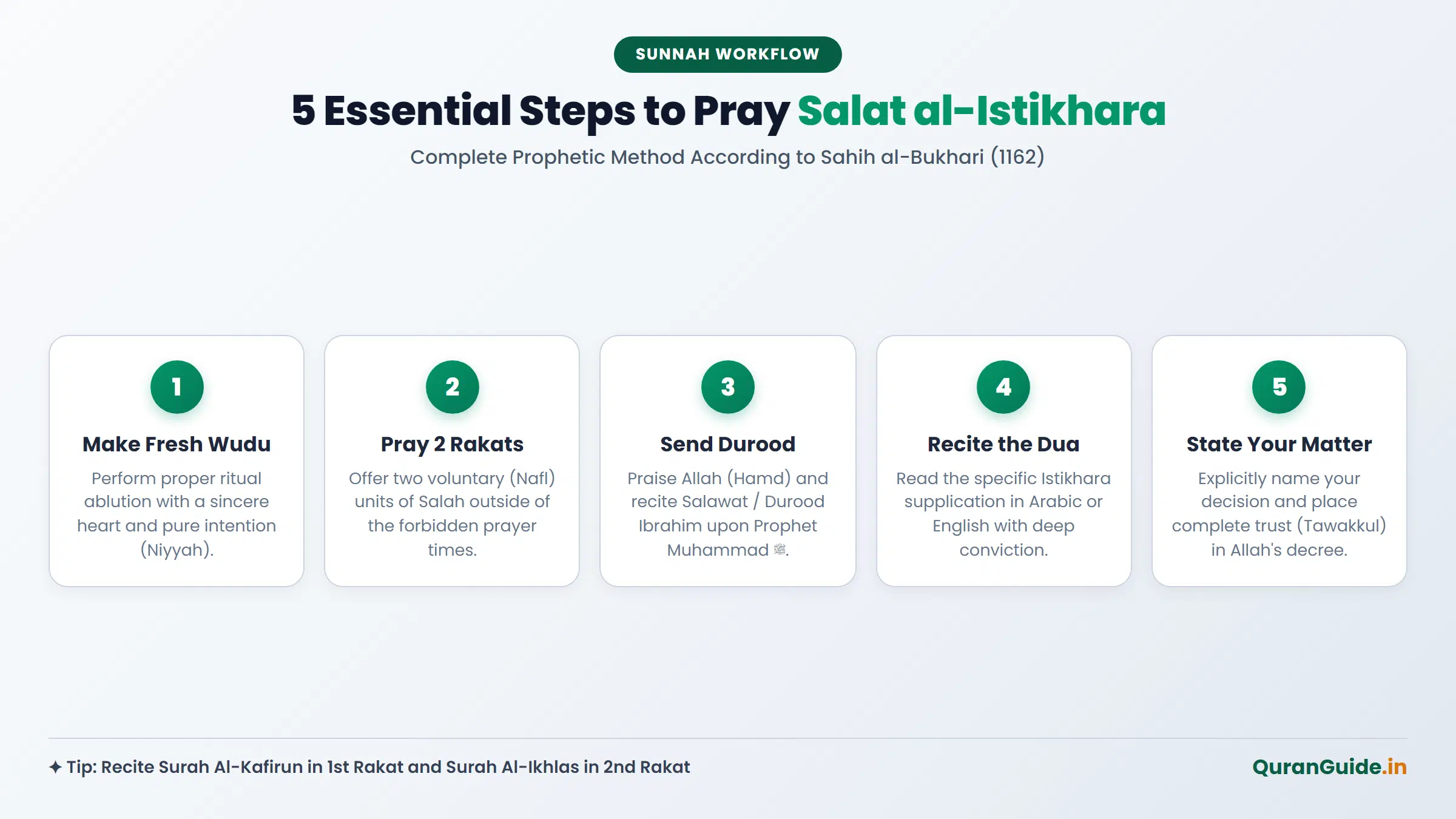
Step 1: Perform Fresh Wudu and Make Your Intention (Niyyah)
Ensure you are in a state of physical and spiritual purity by performing a complete ritual ablution (Wudu). Stand facing the Qiblah and make a conscious, sincere intention in your heart to pray two voluntary units of Salat al-Istikhara to seek Allah’s divine guidance. Vocalizing the intention is not required; the sincere intention of the heart is what matters.
Step 2: Pray Two Rakats of Voluntary (Nafl) Salah
Begin your prayer with Takbirat al-Ihram (“Allahu Akbar”) and pray two ordinary Rakats of Salah just like any standard Nafl prayer:
- In the First Rakat: Recite Surah Al-Fatiha, followed by Surah Al-Kafirun (قُلْ يَا أَيُّهَا الْكَافِرُونَ). Most classical scholars (including Imam An-Nawawi and Imam Ibn Hajar) recommend Surah Al-Kafirun because it establishes complete declaration of Tawhid and disavowal of false deities.
- In the Second Rakat: Recite Surah Al-Fatiha, followed by Surah Al-Ikhlas (قُلْ هُوَ اللَّهُ أَحَدٌ). This reinforces absolute sincerity, reliance, and faith in Allah’s unique sovereignty.
- Complete your Ruku, Sujood, Tashahhud (Attahiyyat), and send blessings upon the Prophet ﷺ (Durood Ibrahim).
Step 3: Praise Allah and Send Durood upon Prophet Muhammad ﷺ
As with all major supplications in Islam, it is recommended to begin by glorifying Allah (praising His Majesty and thanking Him) and sending blessings upon the Prophet ﷺ via Durood Ibrahim. This serves as an honorable opening for your supplication to be accepted.
Step 4: Recite the Authentic Istikhara Dua
Raise your hands with humility, presence of heart, and deep reverence, and recite the specific Dua taught by Prophet Muhammad ﷺ. You can read it from a printed card, phone screen, or book if you have not yet memorized it by heart.
(For a full word-by-word linguistic and pronunciation breakdown, refer to our comprehensive companion article: Istikhara Dua in English, Arabic & Transliteration).
Arabic Text of Istikhara Dua:
«اللَّهُمَّ إِنِّي أَسْتَخِيرُكَ بِعِلْمِكَ، وَأَسْتَقْدِرُكَ بِقُدْرَتِكَ، وَأَسْأَلُكَ مِنْ فَضْلِكَ العَظِيمِ، فَإِنَّكَ تَقْدِرُ وَلَا أَقْدِرُ، وَتَعْلَمُ وَلَا أَعْلَمُ، وَأَنْتَ عَلَّامُ الغُيُوبِ، اللَّهُمَّ إِنْ كُنْتَ تَعْلَمُ أَنَّ هَذَا الأَمْرَ [اذكر حاجتك هنا] خَيْرٌ لِي فِي دِينِي وَمَعَاشِي وَعَاقِبَةِ أَمْرِي – أَوْ قَالَ: عَاجِلِ أَمْرِي وَآجِلِهِ – فَاقْدُرْهُ لِي وَيَسِّرْهُ لِي، ثُمَّ بَارِكْ لِي فِيهِ، وَإِنْ كُنْتَ تَعْلَمُ أَنَّ هَذَا الأَمْرَ شَرٌّ لِي فِي دِينِي وَمَعَاشِي وَعَاقِبَةِ أَمْرِي – أَوْ قَالَ: فِي عَاجِلِ أَمْرِي وَآجِلِهِ – فَاصْرِفْهُ عَنِّي وَاصْرِفْنِي عَنْهُ، وَاقْدُرْ لِيَ الخَيْرَ حَيْثُ كَانَ، ثُمَّ أَرْضِنِي بِهِ»
English Transliteration:
“Allahumma inni astakhiruka bi’ilmika, wa astaqdiruka bi-qudratika, wa as’aluka min fadlikal-‘azim, fa innaka taqdiru wa la aqdir, wa ta’lamu wa la a’lam, wa Anta ‘Allamul-ghuyub. Allahumma in kunta ta’lamu anna hadhal-amra [mention your matter here] khayrun li fi dini wa ma’ashi wa ‘aqibati amri (or ‘ajili amri wa ajilihi) faqdurhu li wa yassirhu li, thumma barik li fih. Wa in kunta ta’lamu anna hadhal-amra sharrun li fi dini wa ma’ashi wa ‘aqibati amri (or fi ‘ajili amri wa ajilihi) fasrifhu ‘anni wasrifni ‘anhu, waqdur liyal-khayra haythu kana thumma ardini bih.”
English Translation:
“O Allah, I seek Your guidance through Your knowledge, and I seek ability through Your power, and I ask You from Your immense bounty. For indeed, You possess power while I have none; You know while I do not know, and You are the Knower of the unseen. O Allah, if You know that this matter [specify your decision here] is good for me in my religion, my livelihood, and the outcome of my affair, then decree it for me, facilitate it for me, and bless me in it. And if You know that this matter is bad for me in my religion, my livelihood, and the outcome of my affair, then turn it away from me, and turn me away from it, and decree for me what is good wherever it may be, and make me content with it.”
Step 5: Explicitly State Your Decision and Place Trust in Allah
When you arrive at the phrase “anna hadhal-amra” (that this matter), pause and name your specific situation in your mind or in your mother tongue (e.g., “accepting this job offer at XYZ company” or “marrying [Name of person]”). Conclude by sending blessings upon the Prophet ﷺ once again.
Should You Recite the Dua Before or After the Tasleem (Salam)?
Scholars have discussed whether the Dua of Istikhara should be recited before saying the Salam (while still seated in the final Tashahhud after Durood Ibrahim) or after concluding the prayer with Salam:
- The Majority Opinion (Jumhur): The majority of scholars from the Hanafi, Maliki, Shafi’i, and Hanbali schools hold that it is recited immediately after the Salam. You finish your two Rakats, say “Assalamu alaykum wa rahmatullah” to the right and left, raise your hands, and supplicate with the Istikhara Dua.
- The Alternative View (Sheikh Ibn Taymiyyah & Ibn al-Qayyim): They considered it permissible and highly virtuous to recite it before the Salam, after the final Tashahhud and Durood, because the Prophet ﷺ frequently made extensive supplications inside the prayer before Tasleem.
Conclusion: Both methods are valid and accepted by classical scholarship, though reciting it with raised hands immediately after the Salam is the most widely practiced Sunnah method.
Crucial Rules and Best Practices for Istikhara
1. Can You Pray Istikhara Without Sleeping?
Yes, absolutely. A very common cultural myth suggests that after performing Istikhara, you must immediately go to sleep facing the Qiblah without speaking to anyone. There is zero authentic evidence for this in the Sunnah. You can perform Istikhara at 10 AM, continue working, go about your normal day, and take practical steps. Sleep is not a condition of Istikhara.
2. How Many Times Can You Repeat Istikhara?
If you remain uncertain or undecided after your first Istikhara, you may repeat the prayer and supplication across multiple days (often 3 to 7 consecutive days). Scholars mention that repeating the prayer deepens humility and allows clarity to unfold naturally.
3. Can Women During Menstruation Perform Istikhara?
Women experiencing menstruation (Hayd) or post-natal bleeding (Nifas) cannot pray the physical 2 Rakats of Salah. However, they can still recite the Istikhara Dua directly as a supplication without the prayer. Allah hears all sincere calls, and seeking divine guidance remains accessible at all times.
Explore Our Comprehensive Istikhara Guides
To deepen your understanding of Salat al-Istikhara, explore our dedicated guides within this topic cluster:
- 📖 Master the Supplication: Istikhara Dua in English, Arabic & Transliteration (Pronunciation & Full Meaning)
- 💍 Marriage Proposals & Nikah: How to Pray Istikhara for Marriage: Signs, Duas & Step-by-Step Guide
- ⏰ Timing & Forbidden Hours: Best Time to Pray Istikhara: Tahajjud, Forbidden Times & Repetition Rules
- ✨ Understanding the Outcome: Istikhara Signs and Results: How Do You Know the Answer? (Dreams vs Reality)
Frequently Asked Questions (People Also Ask)
Can I read the Istikhara Dua from my phone or a piece of paper?
Yes. If you have not memorized the Dua in Arabic, it is completely permissible to read the transliteration or translation from a smartphone, paper, or book. Sincerity, presence of mind, and understanding what you are asking from Allah are the true essence of supplication.
What if I do not see any dream after praying Istikhara?
Seeing a dream is not required and is not the primary way Istikhara works. The true result of Istikhara manifests as peace of heart (Inshirah as-Sadr), practical doors opening easily (Taysir), or obstacles emerging that naturally redirect you away from harm.
Can I combine Istikhara with Tahajjud prayer?
Yes. You can pray your two voluntary Rakats of Istikhara during the last third of the night before Fajr, which is the most blessed time for supplication. You can also make the intention of Istikhara during two voluntary Rakats of Night Prayer (Qiyam al-Layl).
Can someone else pray Istikhara on my behalf?
No. According to the vast majority of authentic scholars, Istikhara is an individual personal act of worship. Just as no one else can pray Farz Salah on your behalf, each individual must personally turn to Allah and perform their own Istikhara.
Conclusion
Salat al-Istikhara is a profound blessing that frees the believer from regret, anxiety, and doubt. By taking the correct practical measures, consulting knowledgeable family and mentors, and performing this beautiful two-Rakat prayer with complete conviction, you rest assured that whatever decision unfolds is backed by the perfect wisdom and divine protection of Allah Almighty.


