
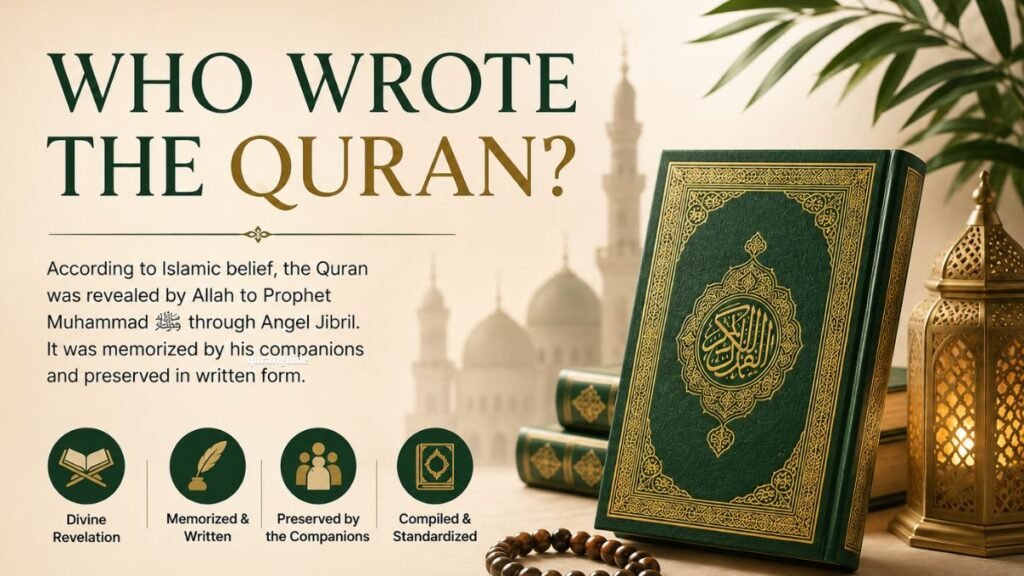
The question “Who wrote the Quran?” has a different answer depending on whether it is being asked from an Islamic theological perspective or as a question about the Quran’s written preservation and compilation.
According to Islam, the Quran was not authored by Prophet Muhammad or another human writer. Muslims believe that the Quran is revelation from God, delivered to Muhammad through the angel Jibril, commonly known as Gabriel. Muhammad then recited the revelations to his followers, who memorized them and also recorded portions in writing.
If you are new to the subject, our guide on what the Quran is provides a broader introduction to its meaning, structure, language, and importance in Islam.
Who Wrote the Quran According to Islam?
According to Islamic belief, God is the source of the Quran.
islam
Muslims believe that the Quran was revealed to Prophet Muhammad over a period of approximately twenty-three years, beginning in the early seventh century. The angel Jibril is traditionally understood to have conveyed the revelation to Muhammad, who then recited it to the people around him.
For this reason, Muslims do not describe Muhammad as the author of the Quran. He is regarded as the messenger who received and communicated the revelation.
This distinction is central to the Islamic understanding of the Quran. Muslims believe its words ultimately come from God rather than from Muhammad’s personal ideas, writings, or teachings.
Did Prophet Muhammad Write the Quran?
In Islamic tradition, Prophet Muhammad is not considered the writer or author of the Quran.
The revelations were recited by Muhammad and learned by his companions. Some companions memorized large portions, while others served as scribes and recorded passages on materials available at the time.
The Quran itself developed within a culture where oral memorization was highly important. Recitation remained one of the main ways the text was transmitted, alongside written records.
So when someone asks, “Did Muhammad write the Quran?”, the Islamic answer is no. Muslims believe he received and recited the Quran rather than composed it.
How Was the Quran Revealed?
Islamic tradition holds that the first Quranic revelation came to Muhammad while he was in the Cave of Hira near Mecca.
Some revelations focused on belief in one God, accountability, the afterlife, and the stories of earlier prophets. Later passages also addressed matters involving worship, family life, social relationships, law, and the developing Muslim community.
Because the revelations came over a long period, the Quran was known and memorized in sections before it existed as a single collected written volume.
Who Recorded the Quran During Muhammad’s Lifetime?
During Muhammad’s lifetime, some of his companions acted as scribes and wrote down Quranic revelations. Islamic historical accounts mention several individuals associated with writing revelation. At the same time, many Muslims memorized passages and recited them regularly.
This combination of oral memorization and written recording played an important role in the preservation of the Quran.
It is therefore more accurate to think of the early Quran as being preserved through a community of reciters and scribes rather than through a single person sitting down and writing an entire book from beginning to end.
When Was the Quran Written Down?
Quranic passages were written during Muhammad’s lifetime, but the process of collecting them into an organized written form continued after his death.
Traditional Islamic accounts explain that the need for a collected manuscript became especially important after some people who had memorized the Quran died in battle.
This led to efforts to gather the Quranic material into a more unified written collection.
The question “when was the Quran written?” therefore has two parts: portions were recorded during Muhammad’s lifetime, while the collection and standardization of the text took place in the early Muslim community after his death.
Who Compiled the Quran?
Islamic tradition commonly associates the first major collection of the Quran with the period of the first caliph, Abu Bakr.
According to traditional accounts, Zayd ibn Thabit, who had served as one of Muhammad’s scribes, was given an important role in gathering Quranic material from written records and memorized recitation.
This collection was intended to preserve the Quran in a reliable written form after Muhammad’s death.
The manuscript was later preserved within the early Muslim community.
What Was Uthman ibn Affan’s Role?
A later and highly important stage took place during the caliphate of Uthman ibn Affan.
As Islam spread into different regions, Muslims from different backgrounds sometimes recited the Quran with variations in pronunciation or reading traditions.
Traditional Islamic histories state that Uthman ordered standardized copies of the Quranic text to be prepared and distributed to important Muslim centers.
This process helped establish a common written form of the Quran across the expanding Muslim world.
Because of this, Uthman is sometimes incorrectly described as the person who “wrote the Quran.” A more accurate description is that he is traditionally associated with the standardization and distribution of an already existing Quranic text.
Has the Quran Changed Over Time?
Muslims traditionally believe that the Quran has been preserved without alteration in its revealed message.
From an academic perspective, scholars study early manuscripts, reading traditions, orthography, and textual transmission to understand how the written Quran developed historically.
Early Arabic manuscripts sometimes differ in spelling conventions, marks, or reading details because written Arabic developed over time. However, these issues are not the same as saying that the Quran was repeatedly rewritten as an entirely different book.
For readers interested in Islamic chronology and dates, our Hijri Date Converter can help convert dates between the Islamic and Gregorian calendars.
What Language Was the Quran Written In?
The Quran is in Arabic, specifically the Arabic associated with the early Islamic period. Arabic remains central to Quranic recitation even among Muslims who speak other languages in daily life.
Translations of the Quran exist in English, Urdu, Hindi, French, Turkish, Indonesian, and many other languages, but Muslims generally distinguish between the original Arabic Quran and translations of its meanings.
That distinction is important because translation always involves interpretation, while the Arabic text holds a unique religious status in Islam.
Why Is Ramadan Important for the Quran?
Ramadan has a particularly strong connection with the Quran in Islamic tradition. Muslims believe the Quran began to be revealed during the month of Ramadan, and Quran recitation becomes especially important throughout the month.
Many Muslims try to read or complete the Quran during Ramadan, attend extended nightly prayers, and spend more time in worship and reflection.
If you are preparing for the next Ramadan, you can also use our Ramadan Countdown to see how much time remains until the expected beginning of the month.
Frequently Asked Questions
Who actually wrote the Quran?
According to Islamic belief, the Quran was revealed by God rather than authored by a human being. Muhammad received and recited the revelation, while companions helped memorize and record it.
Did Muhammad write the Quran himself?
Muslims do not believe Muhammad authored the Quran. He is regarded as the prophet who received the revelation and communicated it to others.
Who compiled the Quran after Muhammad died?
Traditional Islamic accounts associate an early collection with Abu Bakr’s period and Zayd ibn Thabit’s work. Later, Uthman ibn Affan oversaw the standardization and distribution of written copies.
Was the Quran written during Muhammad’s lifetime?
Parts of the Quran were recorded in writing during Muhammad’s lifetime, while many followers also memorized the revelations. The material was later gathered into a more organized written collection.
Who standardized the Quran?
Islamic tradition credits Caliph Uthman ibn Affan with overseeing the preparation and distribution of standardized Quranic copies.
What language is the Quran written in?
The Quran is in Arabic. Its Arabic text remains central to Muslim worship and Quranic recitation.
Conclusion
So, who wrote the Quran? According to Islam, the Quran was not authored by Prophet Muhammad or another human writer. Muslims believe it is revelation from God, conveyed to Muhammad through the angel Jibril.
Muhammad recited the revelation to his companions, who preserved it through memorization and writing. After his death, the Quranic material was collected, and a later standardization process under Uthman ibn Affan helped establish a widely shared written text.


