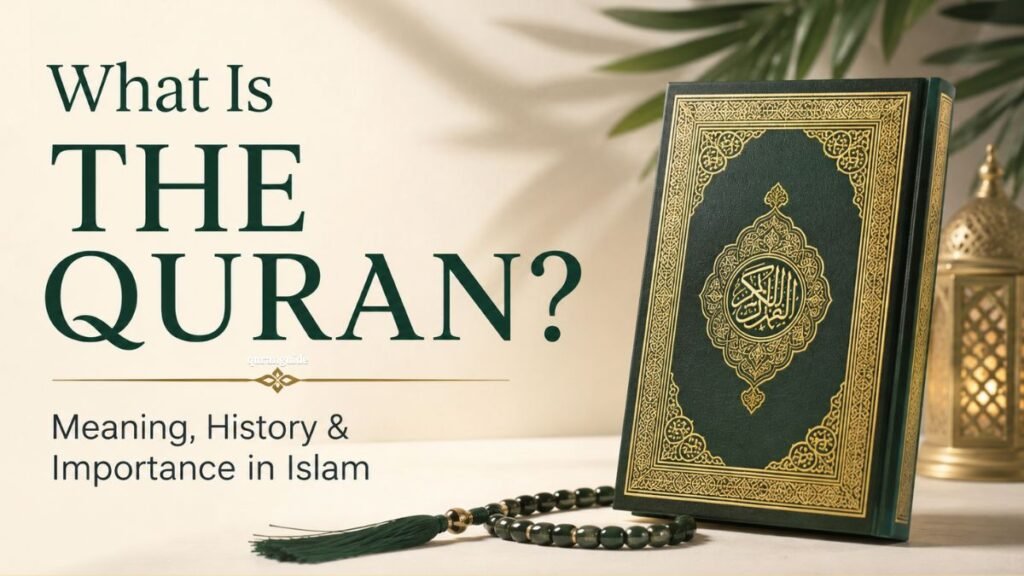
The Quran is the sacred scripture of Islam and the central religious text for Muslims around the world. Muslims believe that it contains the words of God revealed to the Prophet Muhammad through the angel Jibril, or Gabriel, over approximately twenty-three years.
The Quran addresses faith, worship, morality, family life, justice, personal responsibility, and humanity’s relationship with God. It is recited in daily prayers, studied for guidance, memorized by Muslims across different countries, and remains at the heart of Islamic belief and practice.
Quran Definition: What Is the Quran in Simple Terms?
In simple terms, the Quran is the holy book of Islam. According to Islamic belief, it is divine revelation rather than a book written or composed by Prophet Muhammad.
The Quran contains 114 chapters called surahs, which are made up of individual verses known as ayahs. These chapters vary greatly in length and cover many subjects, including belief in one God, worship, moral behavior, stories of earlier prophets, family responsibilities, charity, justice, and the afterlife.
A simple Quran definition would be: the Quran is Islam’s sacred scripture, believed by Muslims to be the revealed word of God and a source of guidance for human life.
What Does the Word Quran Mean?
The word Quran is connected with the Arabic idea of reading or recitation. This is significant because recitation has always been an important part of how Muslims experience and preserve the Quran.
Muslims recite portions of the Quran during their five daily prayers. Many also study its pronunciation through a system known as tajweed, which teaches the rules of Quranic recitation. Memorization is another important tradition. A person who memorizes the entire Quran is commonly known as a hafiz or hafizah.
What Religion Is the Quran Associated With?
The Quran is the sacred scripture of Islam. Muslims believe in one God, known in Arabic as Allah, and regard Muhammad as the final prophet in a long line of messengers.
The Quran also mentions many figures known from Jewish and Christian traditions, including Adam, Noah, Abraham, Moses, Mary, and Jesus. However, these figures appear within the Quran’s own theological framework and are understood according to Islamic teachings.
For this reason, readers may find some familiar names and stories in the Quran while also encountering important differences in interpretation.
Who Was the Quran Revealed To?
According to Islamic tradition, the Quran was revealed to Prophet Muhammad in seventh-century Arabia.
Muslims believe the first revelation came while Muhammad was in the Cave of Hira near Mecca. The revelations then continued at different times during his prophetic mission for approximately twenty-three years.
The Quran was not revealed as a complete book at once. Instead, passages were revealed gradually in different situations. Some came during Muhammad’s years in Mecca, while others were revealed after the Muslim community migrated to Medina.
This gradual revelation helps explain why the Quran addresses a wide variety of religious, personal, and community matters.
What Language Is the Quran Written In?
The Quran is written in Arabic, commonly described as Quranic or Classical Arabic.
Muslims around the world speak many different languages, but the Arabic Quran remains central to Islamic worship. Portions of the Quran are traditionally recited in Arabic during formal prayer, even by Muslims whose first language is not Arabic.
Translations are available in English, Urdu, Hindi, French, Indonesian, and many other languages. These translations help readers understand the Quran, although Muslims often distinguish between the original Arabic text and translations of its meaning because translation inevitably involves interpretation.
How Is the Quran Organized?
The Quran contains 114 surahs. The first chapter is Al-Fatihah, meaning “The Opening,” and the final chapter is An-Nas.
Unlike many modern books, the Quran is not arranged as a continuous chronological story. Its chapters are not generally placed in the order in which Muslims believe they were revealed.
The surahs vary significantly in length. Some contain hundreds of verses, while others contain only a few. For easier reading and recitation, the Quran is also divided into thirty sections known as juz.
Many Muslims read one juz each day during Ramadan so they can complete the entire Quran during the month.
What Does the Quran Teach?
One of the Quran’s central teachings is belief in one God. It repeatedly calls people to worship God alone, act justly, show compassion, care for those in need, seek forgiveness, and take responsibility for their actions.
The Quran discusses prayer, fasting, charity, family relationships, marriage, business dealings, honesty, patience, forgiveness, and social justice. It also places strong emphasis on the Day of Judgment and teaches that people will ultimately be held accountable for how they lived.
Stories of earlier prophets are another major part of the Quran. These accounts are often used to communicate lessons about faith, patience, repentance, trust in God, and the consequences of injustice.
Why Is the Quran Important to Muslims?
The Quran is important to Muslims because they believe it provides divine guidance for both spiritual and everyday life.
Its verses are recited during daily prayers, studied in homes and mosques, and read especially frequently during Ramadan. Muslims may turn to the Quran for guidance, comfort, reflection, and a better understanding of their faith.
The Quran has also shaped centuries of Islamic scholarship. Muslim scholars developed detailed traditions for studying its language, historical context, legal implications, and theological meaning. Quranic commentary is commonly known as tafsir.
How Is the Quran Different From Hadith?
The Quran and hadith are both important in Islam, but they are not the same.
Muslims regard the Quran as divine revelation. Hadith are reports about the sayings, actions, approvals, and practices of Prophet Muhammad.
Hadith literature helps Muslims understand how Muhammad practiced and taught Islam and can provide context for teachings mentioned more briefly in the Quran. However, the Quran holds a unique position as Islam’s primary scripture.
Read More: Quran Guide
How Was the Quran Preserved?
Traditional Islamic accounts describe both memorization and writing as important methods of preserving the Quran during Muhammad’s lifetime. His followers memorized passages, while portions were also recorded in written form.
After Muhammad’s death, early Muslim leaders organized the Quranic material into a written collection. Islamic tradition associates an early compilation with Abu Bakr and a later standardization of written copies with Uthman ibn Affan.
Frequently Asked Questions
Is the Quran the holy book of Islam?
Yes. The Quran is the central sacred scripture of Islam and the primary religious text for Muslims.
Who wrote the Quran?
According to Islamic belief, the Quran was not authored by Prophet Muhammad. Muslims believe it is revelation from God that was conveyed to Muhammad through the angel Jibril.
What does Quran mean in English?
The word Quran is commonly associated with recitation or that which is recited.
What language was the Quran originally revealed in?
The Quran was revealed in Arabic. Translations are available in many languages, but Arabic remains central to Quranic recitation and Islamic worship.
How many chapters are in the Quran?
The Quran contains 114 chapters, known as surahs.
What religion follows the Quran?
The Quran is the sacred scripture of Islam, whose followers are called Muslims.
Conclusion
So, what is the Quran? It is the sacred scripture of Islam, believed by Muslims to be revelation from God given to Prophet Muhammad in Arabic. Its 114 chapters address belief, worship, morality, justice, human responsibility, and life after death.


