
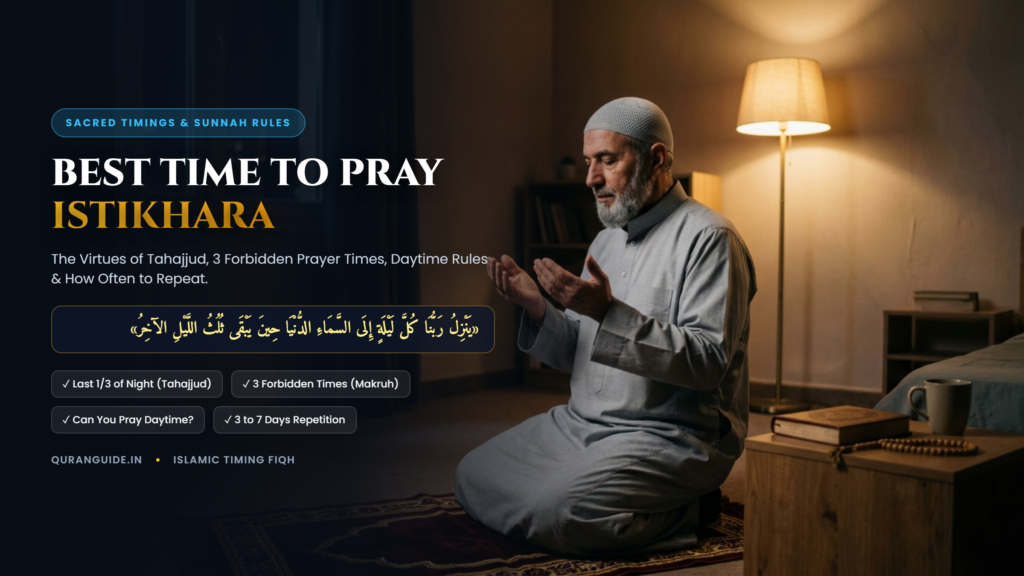
When seeking divine guidance through Salat al-Istikhara (صَلَاةُ الاسْتِخَارَة), many believers wonder: “Is there an exact hour ordained by the Prophet ﷺ to pray? Can I pray Istikhara in the middle of the afternoon, or must I wait until night before sleeping?”
In Islamic jurisprudence (Fiqh), Istikhara is a voluntary (Nafl) prayer that can technically be performed at nearly any point of the day or night. However, Islamic tradition outlines peak golden hours when prayers are answered swiftly, alongside three strictly forbidden times when voluntary prayer is invalid. Understanding the best time to pray istikhara ensures your supplication is accepted with the highest spiritual virtue.
“Our Lord, the Blessed and Exalted, descends every night to the lowest heaven when one-third of the night remains, saying: ‘Who is calling upon Me, that I may answer him? Who is asking of Me, that I may give him? Who is seeking My forgiveness, that I may forgive him?'”
— Sahih al-Bukhari (1145), Sahih Muslim (758)
(Need a full step-by-step walkthrough of the prayer? Read our master guide: How to Pray Istikhara Step by Step: Full Method, Duas & Sunnah Rules).
The Supreme Golden Hour: The Last Third of the Night (Tahajjud)
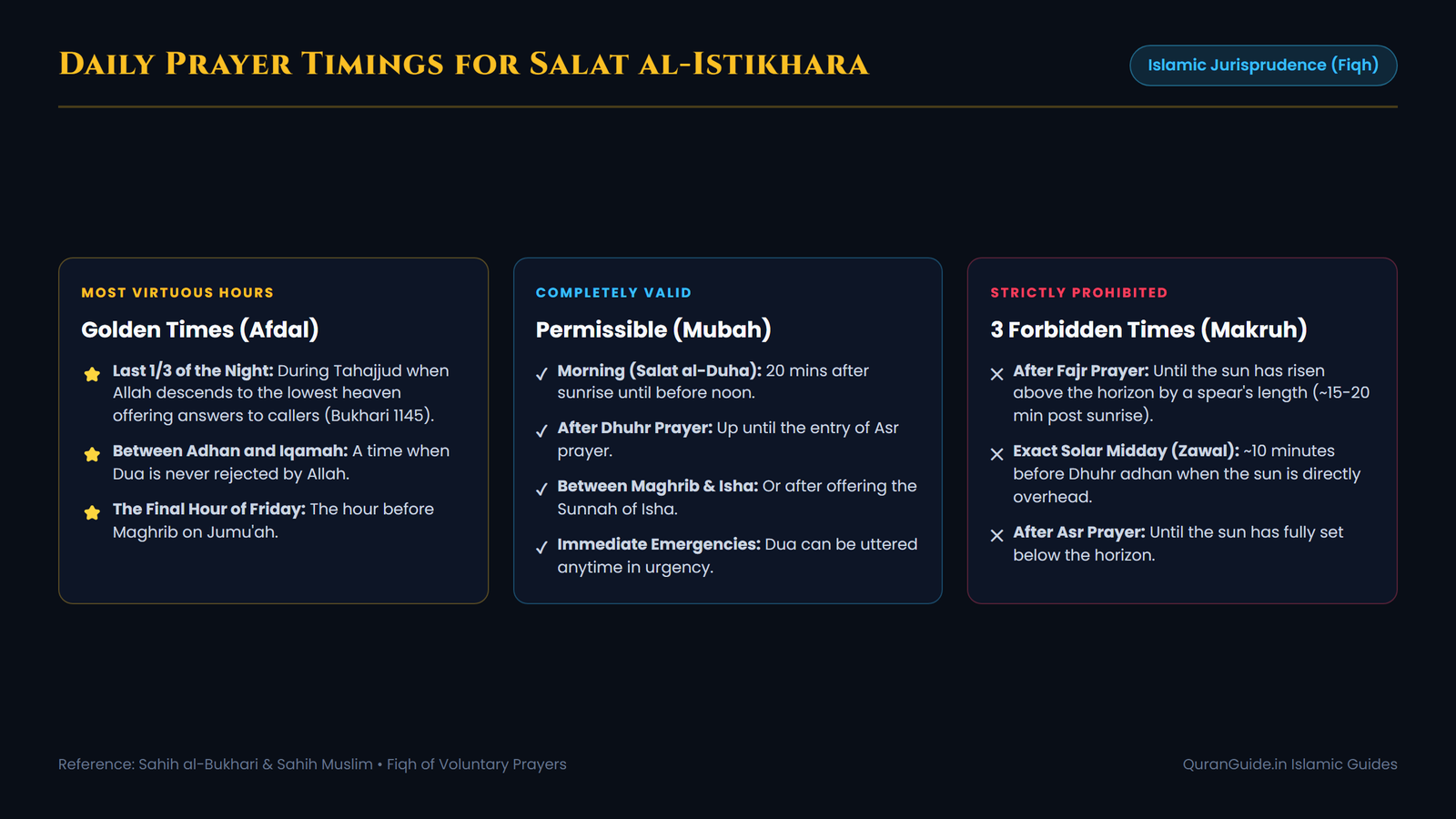
While Salat al-Istikhara is permissible at any non-prohibited hour, classical and contemporary scholars unanimously agree that the absolute best time to pray istikhara is during the last third of the night (Qiyam al-Layl / Tahajjud).
There are profound spiritual reasons why this window is unmatched:
- Direct Divine Descent (Nuzul Ilahi): As authenticated in the Sahih Hadith above, Allah descends in a manner befitting His Majesty to the lowest heaven, actively seeking those who supplicate so He may answer them.
- Absolute Purity of Heart (Ikhlas): At 3:00 or 4:00 AM, the world is asleep. There are no phone notifications, no workplace stress, and no social distractions. Your heart is entirely dedicated to your Lord.
- Heightened Spiritual Humility: Standing before Allah in the quiet stillness breaks personal pride, allowing you to genuinely surrender control of your decision.
How to Calculate the Last Third of the Night: Calculate the total duration from sunset (Maghrib adhan) to dawn (Fajr adhan). Divide this total duration by three. The final one-third portion leading right up to Fajr is the peak time.
Other Highly Recommended Times to Pray Istikhara
If waking up before Fajr for Tahajjud is difficult due to work or illness, you can pray Istikhara during any of these blessed moments:
- Before Going to Sleep (After Isha & Witr): Offer two Rakats of Istikhara after the Sunnah of Isha. This allows your mind to enter sleep in a state of spiritual surrender.
- Between the Adhan and the Iqamah: The Prophet ﷺ said: “A supplication made between the Adhan and the Iqamah is not rejected” (Sunan Abi Dawud 521). Praying your two Rakats in the mosque between the call and the prayer brings tremendous acceptance.
- The Final Hour of Friday (Jumu’ah): Between the Asr prayer and Maghrib on Friday lies the “Hour of Response” (Sa’at al-Istijabah). Since physical Salah is prohibited after Asr, you can recite the Istikhara Dua directly during this hour without praying.
- Mid-Morning Prayer (Salat al-Duha): Approximately 20 minutes after sunrise until before noon is an excellent, tranquil daytime window.
(Looking for the exact wording of the Dua in English and Arabic? Read our companion reference: Istikhara Dua in English, Arabic & Transliteration).
The 3 Forbidden Times You Must NEVER Pray Istikhara
In Islamic Fiqh, there are three specific times of the day (Awqat al-Nahy) when offering voluntary (Nafl) prayers is strictly prohibited (Makruh Tahrimi). You must NOT pray the two Rakats of Istikhara during these intervals:
- After the Fajr Prayer Until the Sun Rises: From the moment you finish praying Farz Fajr until the sun has completely risen above the horizon by the height of a spear (approximately 15–20 minutes after the sunrise time on your calendar).
- Exact Solar Noon (Zawal / Istiwa): Approximately 10–15 minutes before the Dhuhr Adhan, when the sun is at its absolute zenith and shadows are at their shortest.
- After the Asr Prayer Until Sunset: From the moment you conclude the Farz Asr prayer until the sun has completely disappeared below the western horizon at Maghrib.
“Uqbah ibn Amir (may Allah be pleased with him) reported: There were three times at which the Messenger of Allah ﷺ forbade us to pray or to bury our dead: when the sun begins to rise until it is fully up, when the sun is at its height at midday until it passes the meridian, and when the sun draws near to setting until it sets.”
— Sahih Muslim (832)
Crucial Rule on Urgent Matters: If you face an immediate emergency during a forbidden time (for instance, needing to make a critical legal or medical decision within the hour), you can recite the Istikhara Dua directly with raised hands without offering the physical prayer. Duas are permissible 24/7 without restriction!
How Many Times and Days Should You Repeat Istikhara?
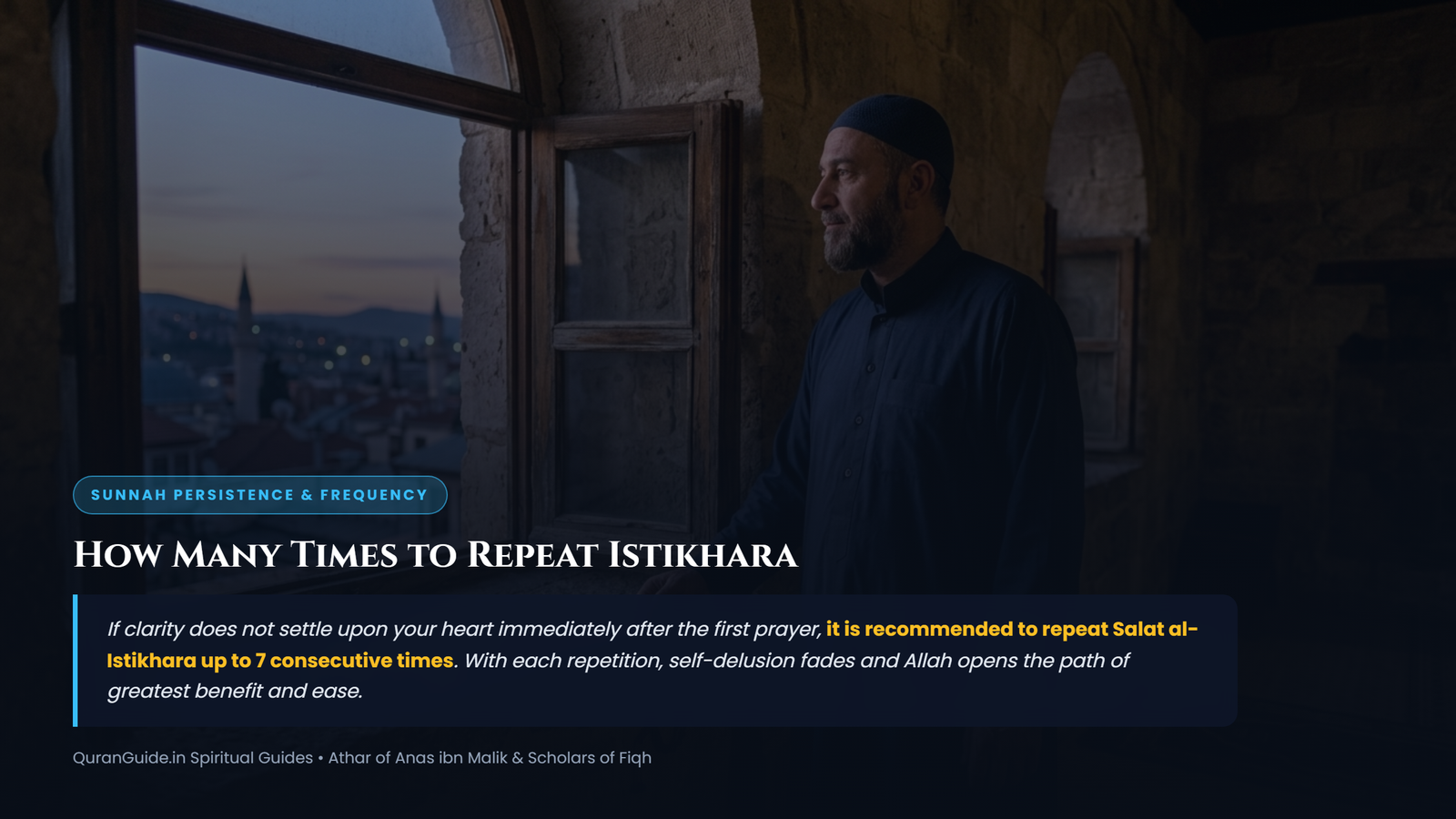
Many Muslims mistakenly believe that Istikhara is a one-time ritual. If clarity, comfort, or logistical resolution does not materialize after your first prayer, it is highly recommended to repeat Salat al-Istikhara up to 7 consecutive days.
A well-known narration transmitted from the noble companion Anas ibn Malik (may Allah be pleased with him) records:
“When you contemplate a matter, make Istikhara to your Lord seven times, then look at what proceeds to your heart, for goodness lies therein.” (Ibn al-Sunni, Al-Adhkar by Imam An-Nawawi).
Each repetition removes emotional bias, silences the ego, and allows divine providence to steer your affairs toward what is truly best.
Debunking Common Myths About Istikhara Timing
Myth 1: You must immediately sleep after Istikhara
Fact: There is zero basis in the Quran or authentic Sunnah requiring sleep after Istikhara. You can pray Istikhara at 9:00 AM, commute to your office, negotiate contracts, and conduct your day as normal.
Myth 2: You cannot speak to anyone after the prayer
Fact: Cultural traditions often claim that speaking breaks the Istikhara. This is completely false. You can speak to your family, consult mentors, and engage in normal speech immediately after finishing your supplication.
(Are you deciding on marriage? See our specialized guide on How to Pray Istikhara for Marriage: Signs, Duas & Step-by-Step Guide).
Explore All Articles in Our Complete Istikhara Series
Complete your knowledge of Istikhara with our full collection of guides:
- Pillar Prayer Guide: How to Pray Istikhara Step by Step: Full Method, Duas & Sunnah Rules
- The Dua Reference: Istikhara Dua in English, Arabic & Transliteration with Meaning
- Marriage Decisions: How to Pray Istikhara for Marriage: Signs, Duas & Step-by-Step Guide
- Interpreting Results: Istikhara Signs and Results: How Do You Know the Answer? (Dreams vs Reality)
Frequently Asked Questions (FAQs)
1. Can I pray Istikhara during the day?
Yes. Any time outside of the three prohibited windows (sunrise, midday zenith, and after Asr) is completely valid for offering the two Rakats of Istikhara prayer.
2. Can I pray Istikhara after Asr if I only recite the Dua?
Yes. The prohibition after Asr applies specifically to physical ritual prayer (Salah). Raising your hands and supplicating with the Istikhara Dua without praying is 100% permissible at any time.
3. What if I fall asleep before praying at Tahajjud?
You can pray your Istikhara early in the morning during Duha time (after sunrise has elapsed by 20 minutes) or immediately after Dhuhr prayer. Allah’s mercy and guidance are never restricted to the night.


