
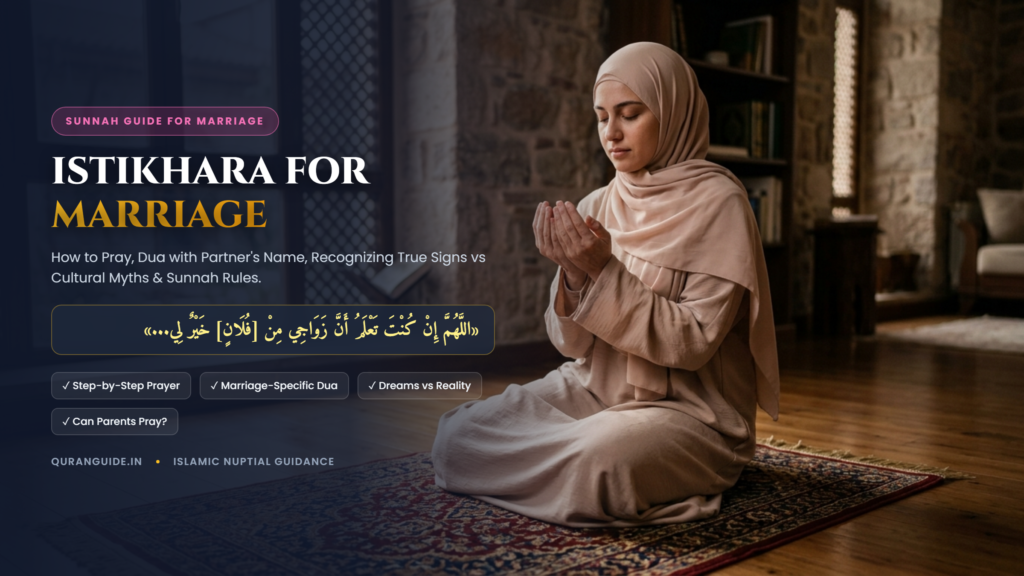
Marriage (Nikah) is one of the most sacred, impactful covenants in Islam, described in the Quran as a “solemn pledge” (Mithaqan Ghalidha). Because choosing a life partner defines your emotional well-being, your children’s upbringing, and your spiritual journey toward Jannah, learning how to pray istikhara for marriage is an indispensable Sunnah for every Muslim seeker.
Many Muslims feel overwhelmed during the marriage search: “Is this person genuinely right for me? What if I make the wrong choice? Will I see a green light or a dream?” This comprehensive guide dismantles cultural myths and walks you through the authentic step-by-step method of performing istikhara for marriage, how to recite the Dua with your prospective partner’s name, and how to recognize the real signs of Allah’s guidance.
“The Messenger of Allah ﷺ taught us to seek guidance from Allah (Istikhara) in all matters, just as he used to teach us a Surah from the Quran.”
— Sahih al-Bukhari (1162)
(For the full linguistic and phonetic breakdown of the supplication itself, see our companion reference: Istikhara Dua in English, Arabic & Transliteration).
The Sunnah Framework: Deen, Mashwara & Istikhara
A frequent error among young Muslims is treating Istikhara like a magical coin toss without doing their basic homework. In Islamic Fiqh, Istikhara works within a structured four-stage decision framework:
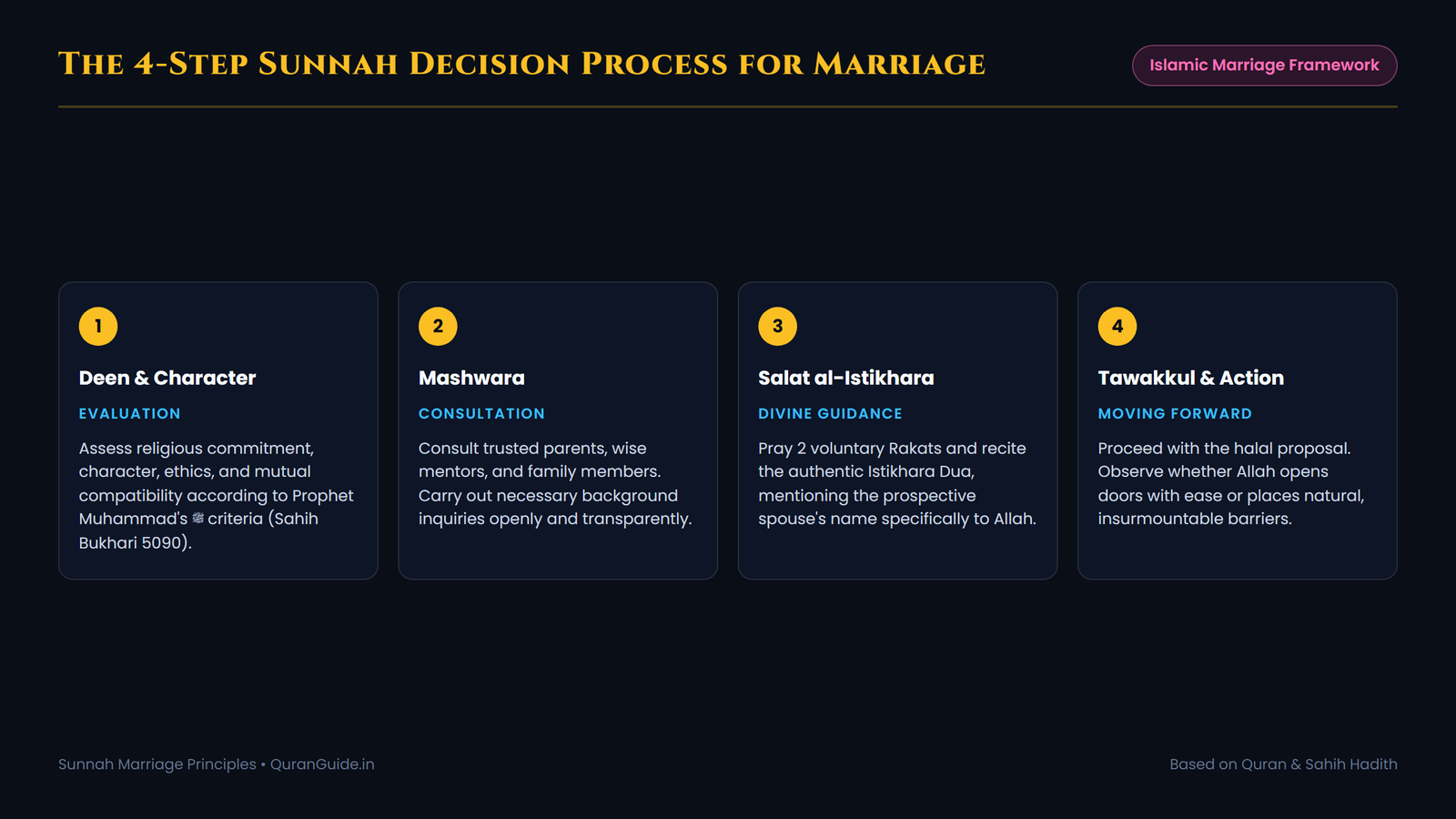
- Evaluate Deen and Character First: Prophet Muhammad ﷺ gave clear criteria: “A woman is married for four things: her wealth, her family status, her beauty, and her religion. So marry the one who is religious, may your hands be rubbed with dust!” (Sahih al-Bukhari 5090). The same standard applies equally to men: look for character (Akhlaq) and religious commitment (Deen).
- Consult Wise People (Mashwara): Discuss the proposal with your parents, trusted scholars, or elder mentors. Verify the person’s temperament, honesty, family dynamics, and financial reliability.
- Perform Salat al-Istikhara: Once you have gathered the facts and feel a reasonable inclination toward accepting or rejecting the proposal, turn to Allah Almighty in prayer to seal the decision.
- Take Action with Complete Tawakkul: Proceed forward with the halal steps and observe how Allah steers the circumstances.
When Exactly Should You Pray Istikhara for Marriage?
You should pray Istikhara when a specific, concrete proposal is on the table and you need to decide whether to proceed or step back. It is not performed for abstract concepts (e.g., “O Allah, show me who my future spouse will be”).
Scholars recommend praying Istikhara at two crucial junctures in the marriage process:
- Before Giving Final Consent: After the initial meeting and mutual family background checks, before formal engagement or Nikah commitment.
- When Overwhelmed with Indecision: If you are torn between two qualified proposals or feeling unresolved anxiety about proceeding to the Nikah stage.
(Curious about the most spiritually potent hours to pray? Read our guide on Best Time to Pray Istikhara: Tahajjud, Forbidden Times & Frequency Rules).
How to Pray Istikhara for Marriage Step by Step
Performing salat al-istikhara for marriage follows the standard Sunnah prayer of two voluntary (Nafl) Rakats, followed by the specific supplication:
Step 1: Perform Wudu and Make Your Sincere Intention
Perform a thorough Wudu. Face the Qiblah and make an intentional resolve in your heart: “I intend to pray two Rakats of Salat al-Istikhara seeking Allah’s guidance concerning my marriage to [Name].”
Step 2: Pray Two Rakats of Voluntary (Nafl) Salah
- First Rakat: Recite Surah Al-Fatiha followed by Surah Al-Kafirun.
- Second Rakat: Recite Surah Al-Fatiha followed by Surah Al-Ikhlas.
- Complete Ruku, Sujood, Tashahhud (Attahiyyat), and send blessings upon Prophet Muhammad ﷺ via Durood Ibrahim. Conclude your prayer with the Salam (“Assalamu alaykum wa rahmatullah”).
Step 3: Recite the Marriage-Specific Istikhara Dua
Immediately after the Salam, remain seated facing the Qiblah. Raise your hands with reverence, glorify Allah, send Durood upon the Prophet ﷺ, and recite the authentic Istikhara Dua, mentioning your prospective spouse’s name at the designated phrase:
Arabic Text with Marriage Mention:
«اللَّهُمَّ إِنِّي أَسْتَخِيرُكَ بِعِلْمِكَ، وَأَسْتَقْدِرُكَ بِقُدْرَتِكَ، وَأَسْأЕЛُكَ مِنْ فَضْلِكَ العَظِيمِ، فَإِنَّكَ تَقْدِرُ وَلَا أَقْدِرُ، وَتَعْلَمُ وَلَا أَعْلَمُ، وَأَنْتَ عَلَّامُ الغُيُوبِ، اللَّهُمَّ إِنْ كُنْتَ تَعْلَمُ أَنَّ زَوَاجِي مِنْ [اذْكُرِ اسْمَ الشَّخْصِ] خَيْرٌ لِي فِي دِينِي وَمَعَاشِي وَعَاقِبَةِ أَمْرِي فَاقْدُرْهُ لِي وَيَسِّرْهُ لِي، ثُمَّ بَارِكْ لِي فِيهِ، وَإِنْ كُنْتَ تَعْلَمُ أَنَّ زَوَاجِي مِنْ [اذْكُرِ اسْمَ الشَّخْصِ] شَرٌّ لِي فِي دِينِي وَمَعَاشِي وَعَاقِبَةِ أَمْرِي فَاصْرِفْهُ عَنِّي وَاصْرِفْنِي عَنْهُ، وَاقْدُرْ لِيَ الخَيْرَ حَيْثُ كَانَ، ثُمَّ أَرْضِنِي بِهِ»
English Transliteration for Marriage:
“Allahumma inni astakhiruka bi’ilmika, wa astaqdiruka bi-qudratika, wa as’aluka min fadlikal-‘azim, fa innaka taqdiru wa la aqdir, wa ta’lamu wa la a’lam, wa Anta ‘Allamul-ghuyub.
Allahumma in kunta ta’lamu anna zawaji min [mention person’s name] khayrun li fi dini wa ma’ashi wa ‘aqibati amri faqdurhu li wa yassirhu li, thumma barik li fih.
Wa in kunta ta’lamu anna zawaji min [mention person’s name] sharrun li fi dini wa ma’ashi wa ‘aqibati amri fasrifhu ‘anni wasrifni ‘anhu, waqdur liyal-khayra haythu kana thumma ardini bih.”
English Translation:
“O Allah, I seek Your counsel through Your knowledge, and I seek ability through Your power, and I ask of Your immense bounty. You possess power while I have none; You know while I do not know, and You are the Knower of the unseen.
O Allah, if You know that my marriage to [Person’s Name] is good for me in my religion, my worldly life, and the outcome of my affair, then decree it for me, facilitate it for me, and grant me barakah in it.
And if You know that my marriage to [Person’s Name] is harmful for me in my religion, my worldly life, and the outcome of my affair, then divert them from me and divert me from them, and decree for me what is good wherever it may be, and make me deeply content with it.”
Istikhara Signs for Marriage: Dreams vs. Real-World Signs
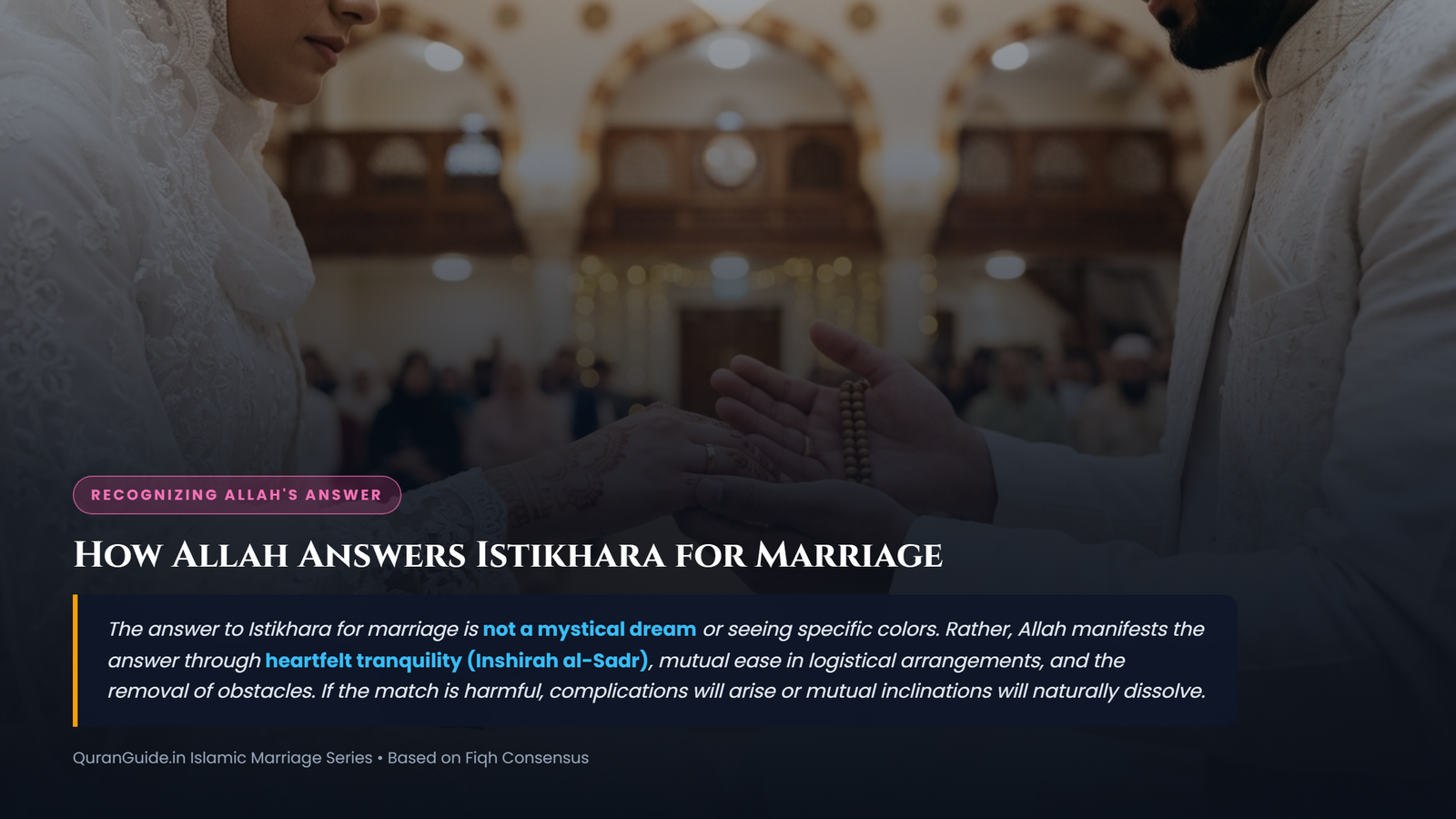
One of the most persistent misconceptions in Muslim communities is expecting a vivid dream showing green pastures, white garments, or glowing light after Istikhara. Prominent classical scholars like Imam An-Nawawi and Ibn Hajar al-Asqalani made it clear: Istikhara does not depend on dreams.
Here is how Allah genuinely answers your Istikhara for marriage:
1. Positive Signs of Istikhara for Marriage
- Expansion of the Heart (Inshirah al-Sadr): An overwhelming sense of clarity, tranquility, and natural comfort replaces previous anxiety.
- Effortless Facilitation (Taysir): Family meetings proceed smoothly, both sides communicate with respect, dates are established easily, and logistical obstacles dissolve.
- Mutual Religious Alignment: You feel inspired to grow closer to Allah together, and both partners show mutual sincerity and honor.
2. Negative Signs of Istikhara for Marriage
- Constriction of the Heart (Diq al-Sadr): A persistent feeling of unease, dread, or intuitive caution that does not go away despite surface attraction.
- Repeated Insurmountable Barriers: Unreasonable demands arise, serious character red flags or deceptions emerge, or communication breaks down irreparably.
- Natural Divergence: If the proposal falls apart, accept that Allah has protected you from unseen future heartbreak, domestic misery, or religious compromise.
(For a full examination of dreams, gut feelings, and post-prayer psychology, see our in-depth article: Istikhara Signs and Results: How Do You Know the Answer? (Dreams vs Reality)).
Important Fiqh Questions on Marriage Istikhara
Can parents pray Istikhara on behalf of their son or daughter?
According to the vast majority of Islamic jurists, the individual who is getting married must pray Istikhara for themselves. The words of the Hadith explicitly state: “If any one of you deliberates upon an affair, let HIM pray two rakats…”. However, parents and loved ones are strongly encouraged to make abundant general Dua (supplication) asking Allah to grant their child a righteous, loving spouse.
What if one person gets a positive feeling and the other gets a negative feeling?
Marriage requires unconditional mutual consent and joy from both parties. If one partner feels a strong negative sign or insurmountable hesitation, they have the full right to decline politely. Allah may decree goodness in different paths for each individual.
How many days should I repeat Istikhara for marriage?
Scholars suggest repeating the prayer and dua across 3 to 7 consecutive days, especially in the last third of the night during Tahajjud prayer, until clarity and peace settle firmly in your chest.
Explore Our Complete Istikhara Guides
Strengthen your knowledge with all guides in this series:
- Pillar Prayer Guide: How to Pray Istikhara Step by Step: Full Method, Duas & Sunnah Rules
- The Dua Reference: Istikhara Dua in English, Arabic & Transliteration with Meaning
- Prayer Timings: Best Time to Pray Istikhara: Tahajjud, Forbidden Times & Frequency Rules
- Interpreting Results: Istikhara Signs and Results: How Do You Know the Answer? (Dreams vs Reality)
Frequently Asked Questions (FAQs)
1. Can I pray Istikhara between two different marriage proposals?
Yes. You can offer separate two-rakat prayers for each proposal, or pray two rakats and mention both options sequentially in separate supplications to see which path Allah facilitates with ease.
2. What if I already love someone? Can I still pray Istikhara?
Yes, but you must strive to empty your heart of emotional bias and genuinely surrender the final outcome to Allah. If you enter Istikhara demanding a specific outcome, you defeat the spiritual purpose of seeking Allah’s wisdom over your desires.
3. Can a woman in menses perform Istikhara for marriage?
Yes. She can raise her hands and recite the Istikhara Dua directly without offering the two Rakats of Salah.


